
AI Receptionist for Small Business: A Buying Guide
Test an AI receptionist for accurate answers, clear handoffs and safe booking. Includes call scripts, failure cases and a practical launch plan.
Key points
An AI receptionist can help answer routine calls, collect a request and guide a caller to the next step. Choose one by testing factual answers, uncertain questions, booking limits and human handoff. Do not judge it only by how natural the voice sounds. A calm, accurate “I need the team to confirm that” is more useful than a confident promise the business cannot keep.
Start with a narrow role and a clear fallback. The goal is to make customers easier to help, including when the assistant cannot finish the task. No system should be described as eliminating missed calls or replacing every human judgment.
Define the job before choosing the voice
Write the receptionist's responsibilities in plain language. It might answer opening-hours questions, collect a service request, identify an existing appointment or offer an approved booking path. Decide what it must not do as carefully as what it can do.
For example, a receptionist can collect the customer's description without diagnosing a technical problem. It can explain the next scheduling step without promising unavailable capacity. It can provide an approved price statement without inventing a quote for an unknown scope.
A useful role statement
“Help callers understand our services and reach the right next step. Use only the approved business information. When the answer depends on a person, a live record or an unverified condition, collect the request and hand it to the team. Do not invent availability, prices or commitments.”
That statement is a starting point for configuration and testing, not a substitute for product controls. The software still needs appropriate permissions and a supported handoff process.
Build a small, reviewed knowledge source
Gather the facts callers regularly need: service area, business hours, contact routes, general service descriptions and the approved booking process. Give each fact an owner who can update it when the business changes.
Avoid uploading a large folder and assuming the assistant will resolve contradictions. Old hours, draft prices and internal notes can produce plausible but wrong answers. Start with a concise, current source and add detail when testing shows a real need.
For each answer, ask whether the receptionist can state it directly or must qualify it. “We offer this service” may be a stable fact. “We can visit tomorrow” depends on availability and authorization. Keep those categories distinct so an informational answer does not become an unintended booking promise.

Test uncertainty deliberately
A good demonstration should include questions the assistant cannot answer. Ask about an unlisted service, an ambiguous location, a price that depends on inspection and an appointment outside available times. Observe whether it admits the limit and offers the correct next step.
Do not reward an assistant for sounding certain when the information is missing. The caller should hear a useful explanation, such as “the team needs to confirm that detail; I can record your request.” That is a successful boundary, not a failed conversation.
Also test a caller who changes their mind or corrects a detail. The final record should reflect the correction, not both conflicting versions presented as facts. Ask a teammate to read the resulting note and explain what the caller actually requested.
Make human handoff concrete
“Talk to a person” needs a real destination and coverage plan. Decide whether the assistant transfers the call, records a callback request or offers another contact method. Explain what happens when the destination does not answer.
Use a callback promise only when someone is assigned to monitor it. If you provide a time window, make sure staffing supports it. Do not create a smooth voice experience that leaves the caller's request in an unattended queue.
Test an unavailable transfer destination. The assistant should recover clearly rather than loop, disconnect without explanation or claim the handoff succeeded. Review the resulting task and notification as well as the audio experience.
Keep booking permissions narrow
A receptionist should distinguish checking availability, requesting a booking and confirming an appointment. Those are different actions. Make sure the customer hears the correct state and that the calendar reflects what actually happened.
Test an existing appointment, a cancellation request and a reschedule. Ask what happens if the caller cannot be confidently matched to the right record. The system should use the supported verification process rather than expose another person's appointment or change it based on a vague name match.
Do not let an assistant improvise exceptions to capacity, service area or business policy. If a human can approve an exception, route the request to that person. Flexibility should be a deliberate decision, not a byproduct of a persuasive caller.

Listen for practical communication problems
A natural voice is only one part of the experience. Test background noise, a caller speaking slowly, an unfamiliar name and someone who interrupts. Check whether the assistant asks for clarification without repeatedly demanding information already provided.
Use the languages your business actually supports and have a fluent person review the result. A translated greeting does not establish that the whole conversation or handoff works in that language. Inspect names, addresses and summaries after the call.
Keep the test respectful and realistic. The purpose is to find limitations before customers encounter them, not to create absurd prompts that say little about daily use. Record the scenario, expected outcome and actual result so configuration changes can be checked later.
Review privacy and sensitive information
Decide what the receptionist should collect and what belongs in another process. Avoid asking callers to provide sensitive payment or identity information when it is unnecessary for the task. Use the approved secure route for documents and payments.
Review recording, disclosure, retention and provider handling with the responsible person for your business and location. This guide does not supply a universal call-recording script or legal rule. Your actual configuration should reflect the applicable requirements and the service you provide.
Check who can access call records and summaries. A helpful summary can still contain private information. Limit access to the people who need it, and make sure exports and connected assistants follow the intended boundaries.
Calculate the cost from actual usage assumptions
List the subscription, telephone service, included usage, additional minutes and any setup or maintenance work. Use your own call pattern as the starting point. Label estimates as estimates and revisit them after a controlled pilot.
Do not compare two receptionists by headline subscription alone. One may include a different amount of usage or require a separate phone service. Ask what happens during long calls, transfers and failed connections, and where charges are visible.
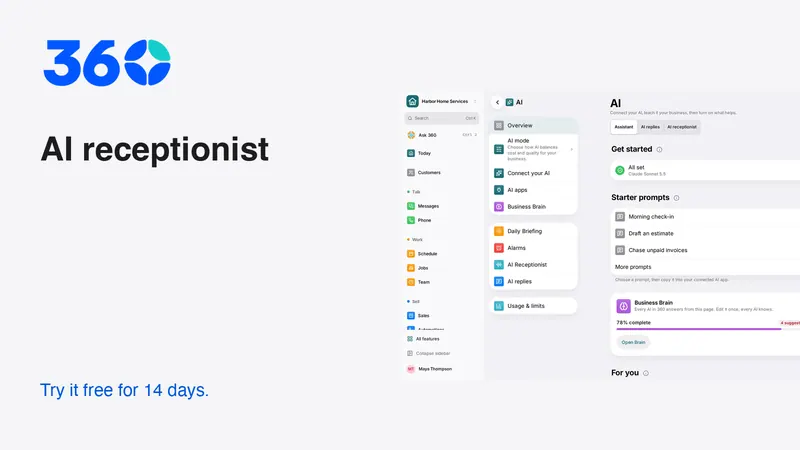
360 offers receptionist tools within its AI feature area. Review current pricing and the in-app setup for the applicable add-on and provider charges. The published business subscription price and 14-day trial should not be interpreted as unlimited voice or AI usage.
Launch with a supervised pilot
Begin with a limited, well-defined call path and a person reviewing outcomes. Use test calls before routing live traffic. Keep a documented way to return to the previous call flow if the pilot reveals a serious problem.
Review the calls that required clarification, handoff or correction. Improve the approved facts and boundaries rather than merely making the greeting more polished. Confirm that customer requests became visible tasks and that someone completed them.
The best result is not a receptionist that speaks endlessly. It is a customer who understands what happens next and a team that receives accurate, actionable context. Keep that outcome at the center of the buying decision.
Frequently asked questions
Can an AI receptionist replace every human call?
No. Complex questions, exceptions, sensitive decisions and uncertain information need a supported human path. Define that path before routing live customers to the assistant.
What is the most important test call?
Test a question the assistant cannot answer and an unavailable handoff destination. Those scenarios reveal whether the system handles limits honestly and creates an actionable next step.
Should I choose the most realistic voice?
Voice quality matters, but accuracy, clear boundaries, booking behavior and reliable handoff matter more. Evaluate the resulting customer record and task as well as how the call sounds.
Try 360 free for 14 days
Put one workflow from this article into practice. $79/month per business, unlimited users, every tool included.
See how 360 fits your trade
Keep reading
Sales & estimates
Never Miss a Lead: Build a Reliable Response Routine
Set up missed-call text-back, clear ownership and useful follow-up. Includes message templates and a test plan for busy small businesses.
AI
Use ChatGPT and Claude With Your CRM Safely
Connect an assistant with limited access, prepare useful drafts and approve changes. A practical guide to business permissions and human review.